How to Identify the Reasons Behind Changes in Animation Style Between Seasons Using Production Staff Information
A new anime season may look noticeably different even when the characters, story, and animation studio remain the same. Faces may have new proportions, outlines may appear heavier, backgrounds may use a different level of detail, or action scenes may rely more heavily on compositing and 3DCG.
These differences are often blamed on “budget cuts,” but finished footage does not reveal a production budget. A visual change may come from revised character settings, different production staff, an episode-specific creative choice, a new compositing pipeline, schedule pressure, or a revised home-video master.
A reliable investigation begins with exact credits and matched footage. It does not begin with a studio name or a general impression of an entire season.

Version-Controlled Comparison Material
Before comparing production staff, identify the footage being compared. The same episode may exist in more than one version:
- Original television broadcast
- Domestic or international streaming release
- Updated streaming master
- Blu-ray or DVD release
- Rebroadcast or remastered edition
Record the season, episode, timecode, provider, country, resolution, and date accessed. For a television recording, include the broadcaster and air date. For a disc, include the volume and release date.
This matters because home-video releases may contain drawing corrections, compositing changes, or replacement shots. Streaming platforms can also receive updated masters, although this does not happen uniformly. A frame from an original broadcast should not be compared with a corrected Blu-ray frame and presented as evidence of a change between seasons.
Use scenes with similar conditions. Compare neutral dialogue shots with neutral dialogue shots, or equivalent action cuts with similar movement. Opening sequences, endings, dream scenes, flashbacks, comedy deformations, and deliberately stylized episodes may follow different visual rules from the main program.
Streaming compression also affects the result. Low bitrates can blur thin lines, produce color banding, or remove texture from dark scenes. These artifacts should not be mistaken for new character designs or reduced drawing quality.
Season-Level Production Staff Comparison
The animation studio is only one line in a large production structure. The same company can assign a different director, animation producer, production desk, subcontracting network, or digital pipeline to a later season.
Start with official opening and ending credits. Official anime websites, theatrical programs, disc booklets, and published staff materials can fill gaps, but the credits attached to the actual episode remain the strongest record of who performed each credited role.
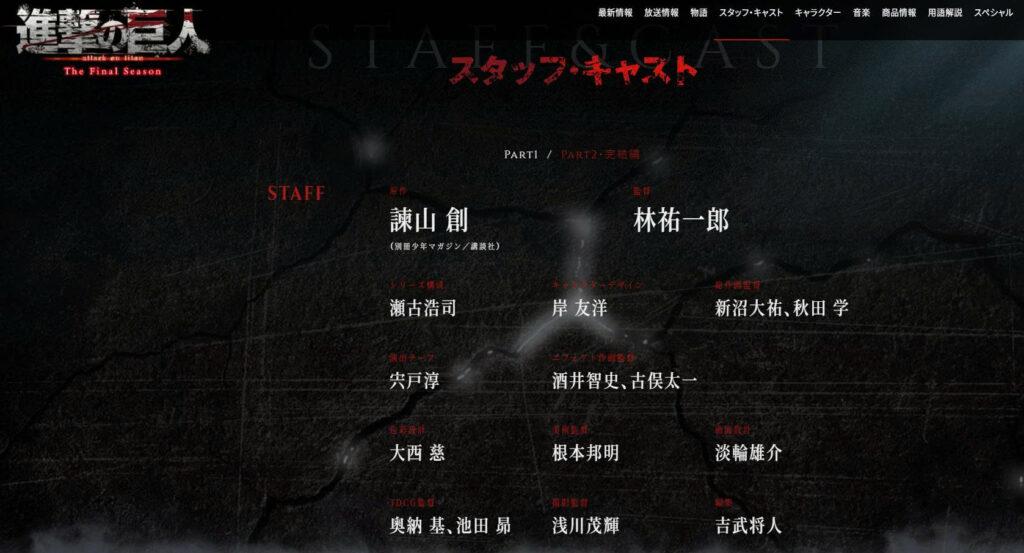
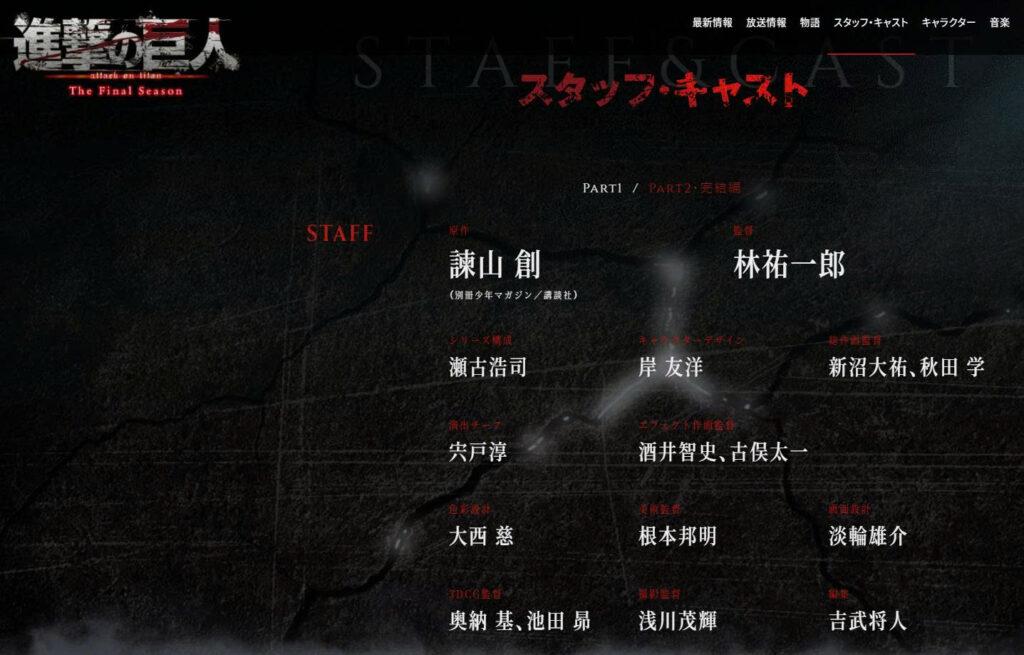
| Production role | Attack on Titan Season 3 | The Final Season Part 1 | Confirmed change and relevant area |
|---|---|---|---|
| Chief director | Tetsurō Araki | No chief director listed | The Final Season used a different top-level directing structure. |
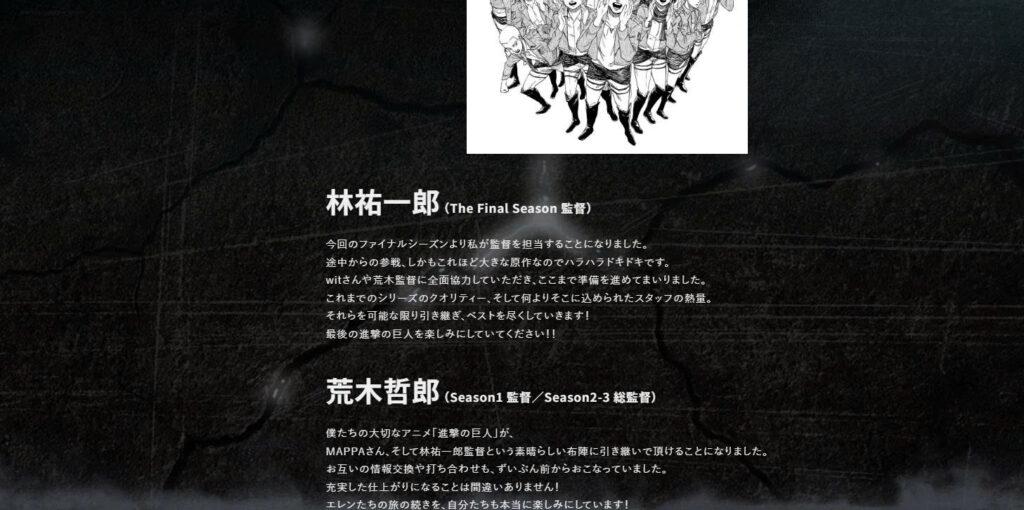
| Director | Masashi Koizuka | Yūichirō Hayashi | Yes. Staging, performance direction, pacing, and overall presentation need to be compared. |
| Series composition | Yasuko Kobayashi | Hiroshi Seko | Yes. Changes may affect narrative organization and pacing, but do not directly prove a drawing-style change. |
| Character design | Kyōji Asano | Tomohiro Kishi | Yes. Official model sheets, facial construction, proportions, and costume details should be compared. |
| Chief animation director | Kyōji Asano and Satoshi Kadowaki | Daisuke Niinuma | Yes. The staff responsible for supervising character consistency changed. |
| Action and effects supervision | Action animation directors Arifumi Imai, Yūko Sera, Takuma Ebisu | Effects animation directors Satoshi Sakai and Taichi Furumata | The credited specialization changed. This is relevant when comparing action cuts and effects animation. |
| Art director | Shunichirō Yoshihara | Kazuo Ogura | Yes. Background treatment, environmental detail, and spatial atmosphere should be examined. |
| Color design | Ken Hashimoto | Ayako Suenaga | Yes. Palette, shadow colors, skin tones, and scene-to-scene color rules may differ. |
| Director of photography | Kazuhiro Yamada | Shigeki Asakawa | Yes. Compositing, lighting effects, depth, contrast, blur, and the integration of visual layers may change. |
| 3DCG director | Shigenori Hirozumi | Takahiro Uezono | Yes. The supervision of 3DCG changed, making Titan rendering and 2D–3D integration relevant comparison points. |
| Animation producer | Not listed on the official Season 3 summary page | Rihito Matsunaga | The official summary pages do not provide a direct season-level match. Individual episode credits or disc materials are required. |
| Animation production | WIT STUDIO | MAPPA | Yes. The production company and its working pipeline changed. |
| Music | Hiroyuki Sawano | Hiroyuki Sawano and KOHTA YAMAMOTO | Partly changed. This affects the audiovisual presentation but does not explain character drawing differences. |
| Sound director | Masafumi Mima | Masafumi Mima | No. This department lead remained consistent. |
Each role affects a different part of the finished work.
The director oversees the overall presentation, working with other department leads on staging, pacing, visual priorities, and performance. A new director can change the visual language, but lighting, color, backgrounds, and compositing are collaborative results rather than the work of the director alone.
Series composition controls the organization of scripts and the broader narrative structure. A change may affect pacing, episode emphasis, or the amount of material covered. It does not directly prove why faces or linework changed.
The character designer adapts source designs into production model sheets. A new designer may alter facial proportions, eye shapes, hair construction, clothing detail, or the amount of information animators must reproduce.
The chief animation director helps coordinate corrections and visual consistency across episodes. Multiple chief animation directors are not evidence of a troubled production by themselves. Duties may be divided by episode, character group, or workload as part of the planned structure.
The art director, color designer, director of photography, and 3DCG director must also be checked. A season can retain the director and character designer while looking different because its backgrounds, palette, lighting, digital effects, or CG integration changed.

Episode-Level Credits and Outsourcing Scope
A striking episode does not always represent the whole season. Television animation is produced in units, and individual episodes may have different storyboard artists, episode directors, animation directors, key animators, and production partners.
For every scene that appears unusually different, record the episode number and timecode. Then check these credits:
- Storyboard: 絵コンテ
- Episode direction: 演出
- Animation director: 作画監督
- Chief animation director: 総作画監督
- Key animation: 原画
- Second key animation: 第二原画
- Production cooperation: 制作協力
- Animation production assistance or subcontracting credits
The storyboard establishes shot structure and visual planning. The episode director interprets that plan during production. Animation directors supervise and correct drawings within their assigned scope. Key animators create the main movement drawings for individual cuts.
A guest storyboard artist or episode director may deliberately introduce unusual framing, timing, or graphic design. A sequence handled by a specialist animator may also look different because that artist was selected for a particular type of action.
Outsourcing requires careful interpretation. Cooperation between studios is a normal part of anime production, including work performed by domestic and overseas partners. A subcontracting credit does not prove that an episode was rushed, inexpensive, or poorly supervised.
Determine what was outsourced. One company may handle in-between animation or finishing, while another receives broader responsibility for an episode. “Production cooperation” can indicate significant episode-level participation, but the exact division of labor must be established through the full credits or a reliable production statement.
Compare several episodes before reaching a season-wide conclusion. If the style change appears only in one episode and its unit credits differ, the likely explanation is local. If it appears consistently across episodes handled by different teams, season-level design or department changes deserve more attention.
Design Settings and Screen Implementation
Character design changes must be separated from changes created during animation, coloring, photography, and compositing.
First, find official model sheets or setting drawings for both seasons. Suitable sources include official websites, licensed guidebooks, exhibition materials, disc booklets, and staff posts that clearly identify the production. Check that both documents belong to the relevant season rather than promotional artwork or merchandise.
Compare stable features:
- Head-to-body ratio
- Jaw and cheek shape
- Eye size, angle, and internal detail
- Hair mass and strand construction
- Nose and mouth placement
- Costume construction
- Shadow and highlight colors
- Standard front, side, and three-quarter views
If these features differ in the official settings, the underlying design changed. The character designer and supervising animation staff become relevant evidence.
If the settings are largely unchanged but the screen looks different, examine implementation. Thin model-sheet lines may appear heavier because of drawing tools, cleanup choices, output resolution, or compositing. A paler face may result from new color specifications, lighting effects, or color correction. Softer images may come from bloom, depth-of-field effects, diffusion, or compression.
The production pipeline contains several separate visual stages. Character and item colors are specified before finishing. Backgrounds are produced under the art department. Colored animation, backgrounds, CG elements, and effects are combined during compositing. Photography work can alter contrast, focus, glow, atmospheric depth, motion blur, and the apparent relationship between 2D and 3D elements.
Movement also affects perceived design. Animation may intentionally stretch, simplify, or distort a character during fast action. Do not use an extreme motion frame as proof that a character was drawn incorrectly. Compare held poses, dialogue shots, and repeated model-dependent views before identifying an off-model pattern.
Interview Evidence and Causal Claims
Staff interviews can confirm whether a visual change was intentional, but only when the source and speaker are properly identified.
Record:
- Speaker’s full name and credited role
- Season or episode for which the speaker was responsible
- Original publication or event
- Interview date
- Original language
- Exact subject being discussed
- Whether the available text is complete or translated
A Season 1 director cannot automatically explain a Season 2 production decision. A character designer may describe revised model sheets but may not know why the photography department changed its effects. A producer may discuss scheduling or staffing but not the artistic reasoning behind an individual cut.
Prefer official interviews, disc booklets, production notes, recorded panels, and direct statements from credited staff. A translated article can be useful for discovery, but important claims should be checked against the original wording. Translation may blur distinctions between design, drawing correction, direction, finishing, and photography.
Separate evidence into three levels:
Confirmed: A responsible staff member directly states that the design, palette, pipeline, or approach changed.
Supported inference: Credits and production materials changed in a way that matches the observed footage, but no staff member has confirmed the reason.
Fan hypothesis: Viewers propose a cause without direct documentation.
Silence is not proof. If no interview discusses the change, report the limits of the available evidence instead of turning a plausible explanation into a fact.
Broadcast, Streaming, and Disc Version Differences
Without matched source files, it would be inaccurate to invent scene corrections or claim that a particular frame was redrawn for Blu-ray. The completed table below identifies the release versions and the conclusions each comparison can support.
| Release version | Exact information to record | Differences that may be visible | Valid interpretation | Unsupported interpretation |
|---|---|---|---|---|
| Original television broadcast | Broadcaster, broadcast date, episode number, timecode, recording resolution | Initial drawings, compositing, broadcast-specific dimming, captions, or transmission artifacts | Establishes how the episode appeared during its documented television broadcast | Does not prove that every later difference resulted from schedule pressure |
| Original simulcast stream | Platform, country, release date, episode number, timecode, selected resolution | Different compression, color range, subtitles, frame blending, or a distributor-specific master | Establishes how that provider delivered the episode in that region on the recorded date | Compression damage should not be described as altered character design |
| Current streaming version | Platform, country, access date, episode number, timecode, resolution | The platform may retain the original master or use an updated one | Allows comparison between the currently available stream and an archived broadcast copy | A current stream should not automatically be labeled the original simulcast version |
| Japanese Blu-ray release | Disc volume, catalog number, release date, episode number, timecode | Possible drawing corrections, effect revisions, replacement shots, or higher-quality encoding | Confirms a disc-version change only when the same frame differs from the broadcast source | Blu-ray should not automatically be called “redrawn” without matched evidence |
| DVD release | Disc volume, catalog number, release date, episode number, timecode | Possible master revisions combined with lower image resolution than Blu-ray | Can confirm whether the DVD uses a revised master when compared directly | Softer DVD lines do not prove simplified animation |
| Rebroadcast or remastered edition | Broadcaster or provider, rebroadcast date, remaster description, timecode | Updated master, altered credits, corrected footage, or changed broadcast processing | Identifies a later television or remastered version | It should not be treated as identical to the first broadcast without verification |
For the Attack on Titan comparison, the correct workflow is to match a Season 3 source and a Final Season source by release type. An original television recording should be compared with another original television recording. Blu-ray footage should be compared with Blu-ray footage. Mixing a broadcast frame from one season with a corrected disc frame from another can exaggerate the apparent seasonal difference.

Evidence-Based Style Change Diagnosis
A dependable investigation follows this order:
- Record the exact season, episode, timecode, and release version.
- Confirm that the perceived difference appears in more than one scene.
- Compare official character settings before judging the finished drawings.
- Tabulate season-level department leads from official credits.
- Check episode-level storyboard, direction, animation supervision, and production partners.
- Separate drawing changes from color, background, photography, and CG changes.
- Search original staff interviews for a confirmed explanation.
- Label every conclusion as confirmed, inferred, or speculative.
Budget, schedule pressure, and staffing availability may influence production, but they cannot be established from appearance alone. The correct conclusion may involve several factors: revised designs, a new photography department, different episode teams, and post-broadcast corrections.
Credits do not turn visual analysis into certainty, but they narrow the possibilities. When the exact version, department, episode unit, and source statement all point in the same direction, a change between seasons can be explained without relying on rumor.